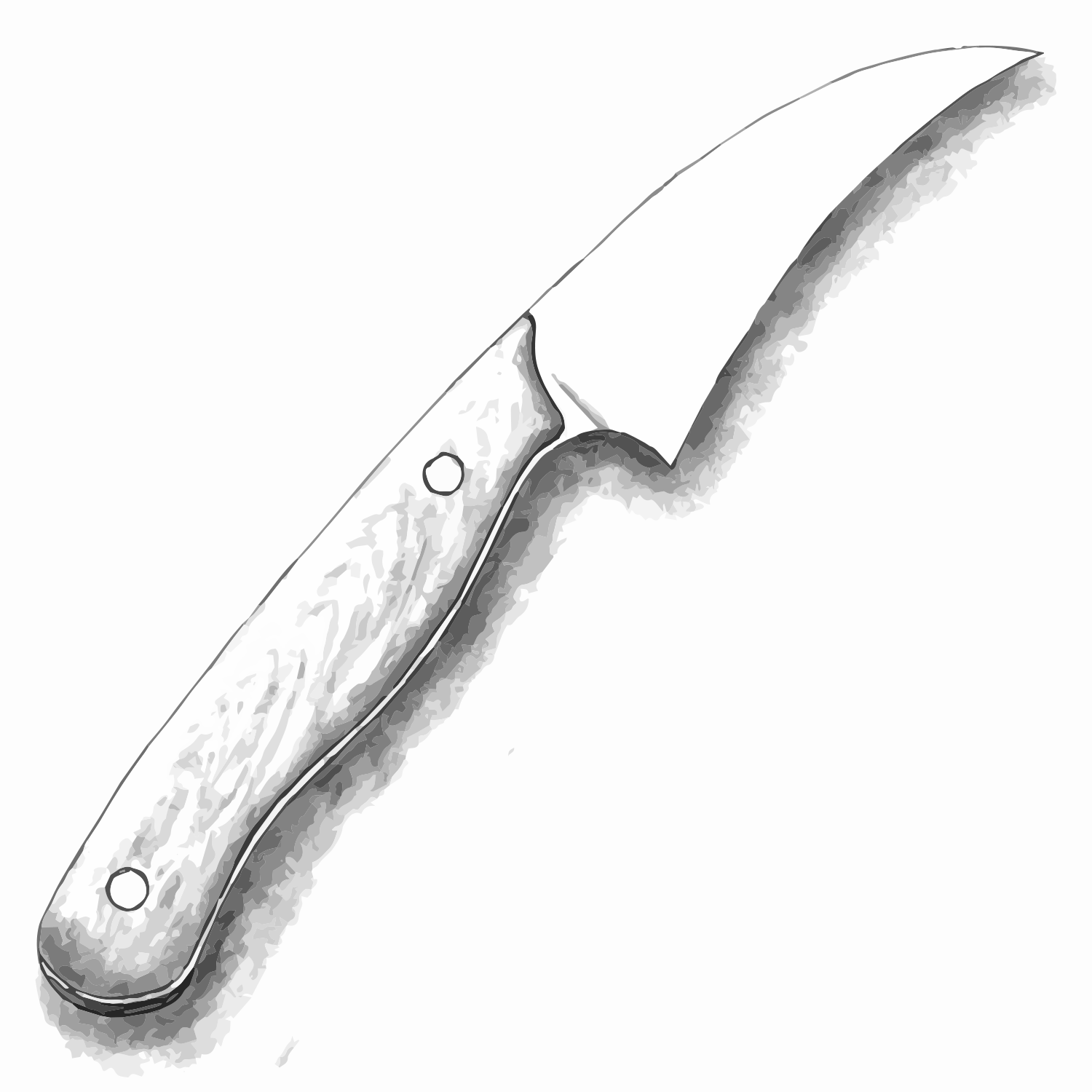
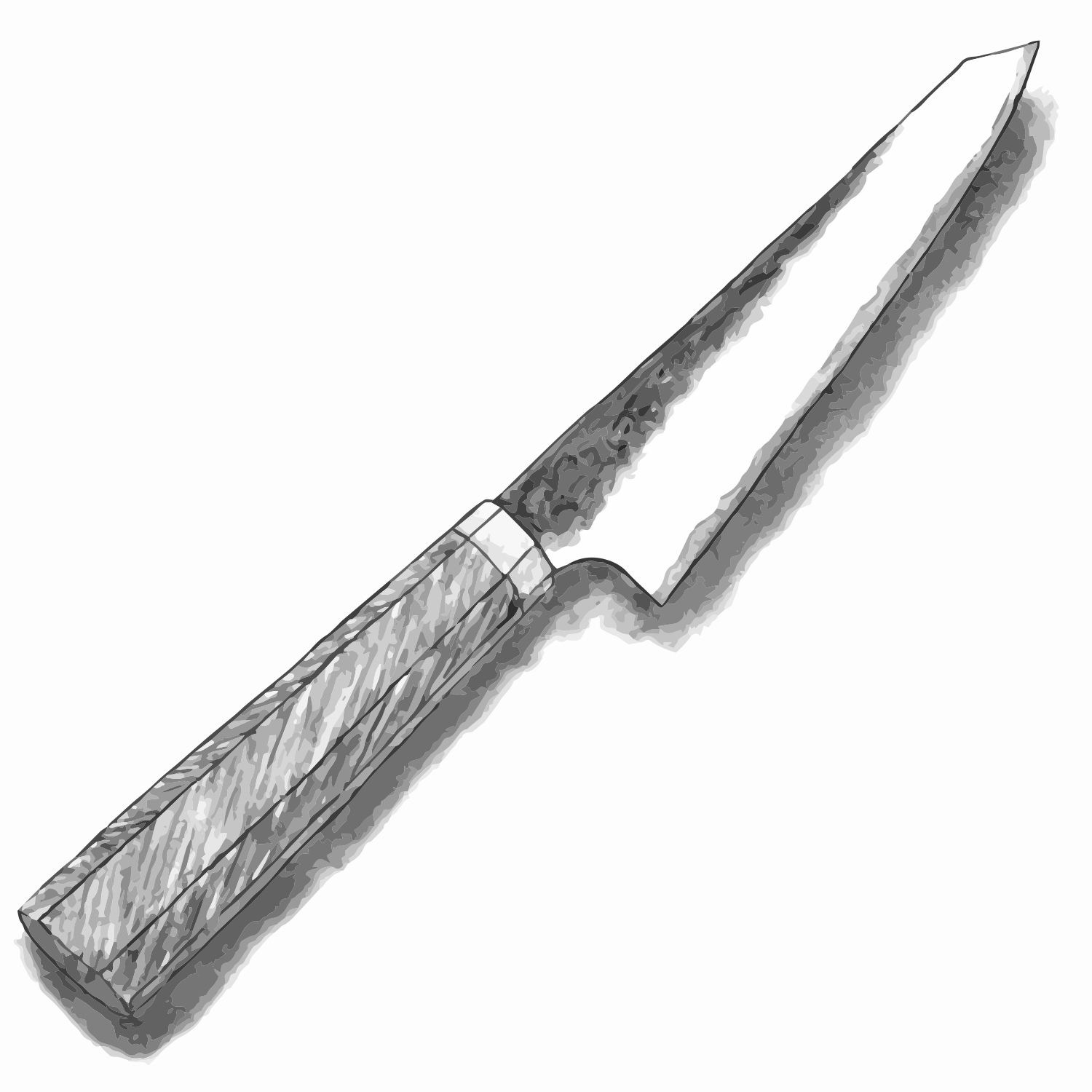
It turns out that in his earliest documented interview, conducted at age three, Shehan Prull named his favorite activity simply as "hammering." His mother would later clarify that this meant hammering nails into a stump, but even then, the impulse was already there.
Shehan began studying metalwork at twelve under internationally recognized artist blacksmith Tom Joyce. By the time he graduated high school, blacksmithing had become less an interest than a calling. After further study in ornamental ironwork, he traveled to Japan as a journeyman, and it was there that a single encounter would redirect the course of his life. He met master knife maker Hiroshi Ashi, who welcomed Shehan into his world and hosted him for the next two years.
Through Ashi-san's patronage, Shehan studied and practiced alongside artisans throughout Sakai, the historic heart of Japanese cutlery. He absorbed not just technique but philosophy, a particular understanding of what it means to make things that are meant to be used, every day, for a lifetime. He also took on decorative ironwork commissions for members of the local community, largely under his own direction, the first time he'd had genuine creative latitude. The resulting work was wild, whimsical, and deeply instructive. It was here that technical rigor and personal expression first began to coexist in his practice.
Shehan returned to Santa Fe in 2009 determined to build a workshop and a knife-making practice grounded in everything he'd absorbed in Japan. He funded the import and construction of essential equipment by taking on decorative ironwork commissions, a pragmatic bridge between where he was and where he intended to go. By 2012, his shop was fully operational, and he began producing knives in earnest.
For nearly eight years, he worked much as the Japanese shops where he trained had worked: designing and producing refined versions of classic kurouchi and sanmai kitchen knives, steadily improving process, efficiency, and consistency. The repetition was formative. It sharpened not only his technical command but his understanding of what separates a good tool from an exceptional one.
And yet, mastery achieved is not the same as curiosity satisfied. After nearly a decade, Shehan felt the restlessness that tends to arrive when a maker has pushed a form as far as it will go within the constraints of production. He stepped away from inventory to pursue experiments and ideas that had long been waiting, technically demanding, conceptually ambitious work that production schedules simply don't allow.
The work that emerged draws on ginsugi and yobitsugi, Japanese techniques historically used in the artistic repair of lacquerware and ceramics. Where kintsugi employs gold to bond broken pieces and celebrate imperfection, ginsugi uses silver, and yobitsugi patches together fragments of entirely different objects into something new. Shehan translates these philosophies to the knife blade: joining mild steel to high-carbon steel cores through scarfed connections of brass and tin, then working those joints into imagery of deliberate beauty. The result is a body of work in which the seam between materials is never hidden. It is rendered as ornament, as narrative, as the thing the eye travels to first.
He is drawn, too, to the moment of fracture itself. The way materials break is never truly random. Cracks and splits follow invisible laws, tracing paths governed by physics that usually goes unseen, producing patterns that mirror the fracture lines in cooling lava, the network of a river delta seen from above, the way frost traces its path across cold glass. There is beauty in those patterns, and meaning. Shehan works in that space, finding in the seam and the split not a flaw to be corrected but a window into the hidden order of things.
In many ways, it feels like a return to his time in Japan: a moment of freedom, reflection, and genuine exploration.
Shehan and Eatingtools founder Abe Shaw first connected in California around 2021, where they spoke openly about the possibility of working together. The vision was clear. The timing wasn't. Nearly five years later, with Shehan's newest body of work now emerging, innovative and uncompromising in equal measure, it finally is.